Sunday, May 26, 2013

Supply Shock: Ecological Economics Comes of Age | Peak Oil News ...

Supply Shock: Ecological Economics Comes of Age thumbnail

The ideas which are here expressed so laboriously are extremely simple and should be obvious. The difficulty lies, not in the new ideas, but in escaping from the old ones, which ramify, for those brought up as most of us have been, into every corner of our minds.
John Maynard Keynes

Of all the critiques of mainstream economics, Third World, feminist, Austrian, radical, Georgist, Marxist and others, the one our grandkids would have us heed most is the ecological critique. The ecological critique says that mainstream economics has ignored some extremely important scientific principles that are especially relevant to economic growth in the 21st century. These principles, taken together, make it abundantly clear that there are limits to population growth and to the production and consumption of goods and services, no matter how efficiently we try to produce and consume. In other words, these principles make it clear that there is a limit to economic growth. Therefore, a full world in pursuit of economic growth finds itself in violation of the laws of nature and is penalized accordingly. As they say, ?Nature bats last.? Unfortunately, the penalties will be most severe for the grandkids, and this will be supremely unfair because the grandkids will have had no say in the formulation of our economic goals.

The ecological critique of mainstream economics is so strong and compelling that a large and growing academic movement has formed around it. This movement is called ?ecological economics,? no less, and is more or less embodied in the International Society for Ecological Economics, or ISEE.1

There are ISEE chapters representing the United States, Canada, Europe, Russia, Australia and New Zealand, Brazil, Argentina, and India.

As with most movements, there are various views on how ecological economics originated. However, at least three couplings of people and their thought-provoking writings would be prominent in any discussion of ecological economics history. One is the controversial book by Donella Meadows, Dennis Meadows and Jorgen Randers called Limits to Growth, published in 1972. Another is the highly theoretical work of the Romanian professor Nicolas Georgescu-Roegen, summarized in his book The Entropy Law and the Economic Process (1971). The third would be the profound but down-to-earth work of Herman Daly on the steady state economy, featured in books such as Valuing the Earth (1993), For the Common Good (1994) and Beyond Growth (1997).

Limits to Growth was a cornerstone of the American environmental movement and was eventually translated into 30 languages.

The authors, based at the Massachusetts Institute of Technology(MIT) and commissioned by the Club of Rome, developed a computer model demonstrating how economic growth was leading to natural resource depletion and environmental degradation. Two of the computer scenarios, including a ?business as usual? scenario and a dramatic technological progress scenario, predicted a disastrous collapse of the economy during the 21st century. The third scenario was essentially the steady state economy and assumed concerted efforts to stabilize the system. The book and its authors suffered a politically debilitating attack in the decades following its publication. At first, economists in academia chipped away at details, but soon pro-growth, free-market organizations such as the Competitive Enterprise Institute and Cato Institute piled on with an overarching accusation of ?pessimism.? Such criticism was similar to the 19th-century criticism of Malthus?s Essay on Population and is hard to read without countering: ?Don?t throw the baby out with the bathwater.? Perhaps Meadows and her colleagues weren?t spot-on with every detail, but the principles they laid out were undeniable and the scenarios were rigorously constructed. Decades later analysts are documenting how prescient the authors of Limits to Growth were, especially with the business as usual scenario.2

In contrast to Limits to Growth, Georgescu-Roegen?s masterpiece went mostly unnoticed in academia and was entirely ignored in public dialog. It?s effect has been like the hands of time, tick-tocking perpetual growth notions into the dustbin of yesteryear?s fantasies. The slow but sure ticking is apropos, given that The Entropy Law and the Economic Process is all about ?time?s arrow,? or the entropy law.

The entropy law is a foundational concept in physics: the second law of thermodynamics no less. Perhaps the quickest, easiest way to describe it is that energy inevitably, invariably dissipates.

Things that are hotter than their environment cool off. Of the billions of cups of coffee poured in the broad sweep of history, not one has warmed up of its own accord, not for an instant. The entropy process is as consistent and irreversible as Father Time; you can tell whether it?s earlier or later based on the warmth of your coffee. Einstein said of the entropy law, ?It is the only physical theory of universal content, which I am convinced . . . will never be overthrown.? Einstein was also impressed by the entropy law?s ?range of applicability.?3

And apply it Georgescu-Roegen did, unto 457 pages! The main application, in a nutshell, is that absolute efficiency in the economic production process cannot be achieved. Nor can recycling be 100 percent efficient. Pollution is inevitable, and all else equal, more economic production means more pollution. These findings may seem like no-brainers to many, yet neoclassical growth theory has led to wild-eyed optimism regarding ?green growth? and ?closing the loop? by turning all waste into capital. Such fantasia cannot be soundly refuted without invoking the entropy law.

The Entropy Law and the Economic Process moves across a huge swath of philosophical and scientific terrain. As with most wide-ranging and intellectually adventurous books, The Entropy Law can and has been challenged. Most of its arguments and the counterarguments are philosophical and not amenable to scientific proof or disproof. But the tremendous value of The Entropy Law is that it unequivocally established the profound relevance of thermodynamics to economic affairs. Unlike neoclassical economics, ecological economics embraces this relevance, putting ecological economics into a better position for enlightening real world affairs.

With regard to real world affairs, though, The Entropy Law as a book was not as useful as the entropy law itself. It was abstruse enough to appear esoteric, and Georgescu-Roegen?s interests in economic affairs tended to be exceedingly long-term. While neoclassical economists pushed a perpetually growing economy, Georgescu-Roegen emphasized a perpetually eroding economy and indeed a perpetually eroding universe, all the way out to the ?heat death? necessitated by infinity. This emphasis had the ironic effect of retarding the application of The Entropy Law and the Economic Process to the economic process itself.

Fortunately for ecological economics, one of Georgescu- Roegen?s students at Vanderbilt University was Herman Daly. A devout Christian, Daly too had an eye toward the longest of long terms, but he also had one eye focused on the wellbeing of present and upcoming generations. This tapestry of long- and short-term interests can be sensed throughout Daly?s writings. Daly took the entropy law, emphasized its short-term relevance while acknowledging its long-term implications, and used it as part of a well-grounded macroeconomic framework. He called this framework ?steady state economics,? which served as the catalyst for the ecological economics movement. Much of the remainder of this book is a natural progression from Daly?s steady state economics.

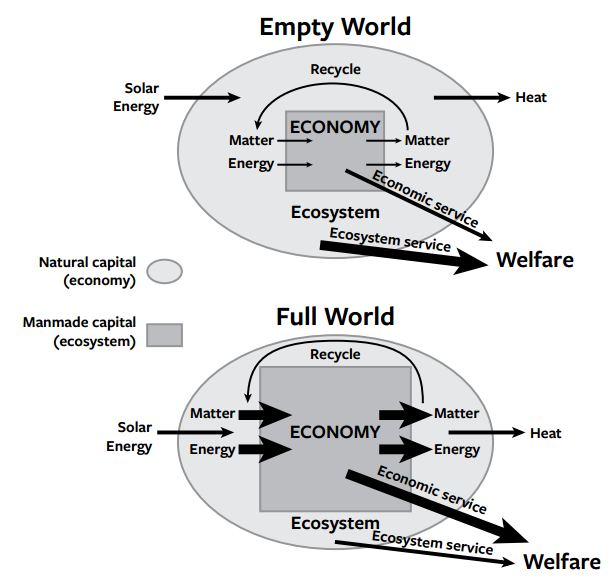
Figure 6.1. Herman Daly (top left) and Donella ?Dana? Meadows (top right), founders of ecological economics. Daly and colleagues clarified the relationship between the economy and earth with a diagram (above) that was simple but powerful for illustrating limits to growth. Credits: (top left) Herman Daly; (top right) Donella Meadows institute; (above) From Ecological Economics, Herman e. Daly and Joshua Farley, ?2004 Herman e. Daly and Joshua Farley. reproduced by permission of island Press.

With the passing of Georgescu-Roegen (1906?1994) and Donella Meadows (1941?2001), of the three only Daly, a professor emeritus with the University of Maryland, remains a major figure in ecological economics.4

For the Common Good (co-authored with the theologian John Cobb) received the prestigious Grawemeyer Award for Ideas Improving World Order. Daly was also the recipient of the Honorary Right Livelihood Award (Sweden?s alternative to the Nobel Prize) and the Heineken Prize for Environmental Science from the Royal Netherlands Academy of Arts and Sciences. Daly is no ivory-tower academic, either, having spent six years as a senior economist at the World Bank. The National Council for Science and the Environment presented Daly with its Lifetime Achievement Award in 2010. The tremendous respect for Daly is displayed in a festschrift authored by colleagues, students and admirers.5

Of course, it is somewhat arbitrary to classify these relatively recent efforts as the ?roots? of ecological economics. We saw in Chapter 3 that the classical economists, most notably Malthus, recognized limits to economic growth. John Stuart Mill went further and elaborated on the ?stationary state.? Daly?s steady state economy is essentially the resurrection of Mill?s stationary state, supplemented with a rigor gleaned from the natural sciences, an economic mastery honed in academia and first-hand experience with economic growth policy as implemented by the World Bank. After six years at the Bank, Daly left in disgust, noting the blind faith in neoclassical economics among the Bank?s highest-ranking economists.6

He offered the hopeful observation, however, that the Bank was becoming ?more environmentally sensitive and literate.?7

Daly was modest, for the newfound environmental sensitivity wasn?t foisted onto the Bank by Wall Street or the Competitive Enterprise Institute. In fact, we have the likes of Daly himself and a noteworthy colleague at the bank, Robert Goodland, to thank.

With that brief historical account as background, the remainder of this chapter will comprise an overview of ecological economics, with an emphasis on how ecological economics treats the subject of economic growth. As with conventional economics, ecological economics can be broken down into micro- and macroeconomics.

Ecological economics is founded upon different principles, micro and macro, which lead to distinct conclusions and policy implications. These principles stem from the natural sciences (physical and biological) that are largely ignored in conventional or neoclassical economics.

While we keep the micro-macro distinction in mind, it will also be useful to think of three themes: allocation, distribution and scale. ?Allocation? refers to the way the factors of production are devoted to different producers for different purposes. For example, land may be allocated among farming, forestry, recreational and other uses. Labor and capital may be allocated likewise. At a finer level, timber from a forest may be allocated among furniture-making, construction, boat-building, etc. Labor at the construction site may be allocated among carpentry, masonry and plumbing.

Capital at an automobile plant may be allocated among the chassis, drive-train and circuitry floors. The efficiency of an economy depends to a great extent upon a well-balanced allocation among and within the factors of production.

?Distribution? refers to the distribution of income, wealth or general welfare. This is the economic subject most often discussed by non-economists. Indeed, politics is mostly about distribution, which explains the classic definition of politics: ?Who gets what, when, and how.?8

Bill Clinton could have elaborated, ?It?s the political economy, stupid!?

?Scale? refers to the size of the human economy relative to the ecosystem. This, of course, is our focus here, and it provides the primary distinction between neoclassical and ecological economics. Neoclassical economics deals almost exclusively with allocation and, to a much lesser extent, distribution. Why? Because neoclassical economics doesn?t recognize environmental limits to economic growth. With no limit to growth, the concept of scale is superfluous, there is no conflict between growth and the environment, and the cure for social ills including maldistribution of wealth is always more growth. ?A rising tide lifts all boats,? as they say.

Ecological economics deals with allocation and distribution, but its emphasis is on scale, especially among the scholars and policy activists we might call ?Dalyists.? Scale deals with whole economies, usually national or global, so ecological economics is geared especially to replace conventional macroeconomics while accepting and incorporating some of the fundamentals of conventional (neoclassical) microeconomics. Before we delve into scale, however, let us briefly consider allocation and distribution from the perspective of ecological economics.

Ecological economists acknowledge that the market that ubiquitous place where goods and services are exchanged is reasonably efficient at allocating resources. The market is especially efficient when property rights are easily established and readily enforced. This is not the same as saying prices are a good indicator of absolute or long-run scarcity. For example, even if the market price of petroleum is far too low for the sake of the grandkids, allowing us to pull the carpet from under their future, the market will do a reasonably good job of allocating petroleum among today?s power plants, airlines and trucking companies. For example, there won?t be a huge surplus of petroleum at the power plant if the trucker down the road is desperate for gas. The fact that the invisible hand can handle this allocation problem is good indeed. Today?s consumers will not only have electricity from the power plant, but goods hauled in by the trucker.

Adam Smith described this process in detail but also noted several problems, including monopolies and misinformed consumers. Such problems prevent the market from performing properly.

Few have argued that point, and economists of all stripes talk about ?market failure? and how to correct it. Nevertheless, neoclassical economists place a notorious amount of faith in the market. The invisible hand, they say, ensures that microeconomic behavior produces a desirable macroeconomic outcome. Supply and demand establish prices that send appropriate signals to producers and consumers, leading to economic activity that serves society?s interests. For example, as a natural resource becomes scarcer, the price of it rises, resulting in more vigorous efforts to supply the resource.

Theoretically, this will take care of the grandkids as well as today?s consumers. Richard Norgaard, a professor at the University of California, Berkeley and past president of the ISEE, points out the fallacy inherent to the neoclassical theory of prices.9 The theory implies that she who sells the resource knows whether the resource is scarce or not. Otherwise, how would she know where to set the price? Yet how was she supposed to know how scarce the resource was, if price was supposed to tell her? It?s a catch-22.

This is an important critique, because economists often argue that natural resources are actually becoming more plentiful just because prices are declining. (Not that many prices are declining today.) The late Julian Simon (1932?1998) famously peddled such pap, spawning disciples who found Simon?s argument conducive to increasing their own money supplies. After all, their ?theory? feeds straight into the hands of corporations that benefit from the resulting, pro-growth mindset of consumers and policy makers. The corporate community loves these disciples of Simon, and the new darling is the Danish statistician Bjorn Lomborg. Praise has been heaped upon Lomborg by the likes of the Competitive Enterprise Institute for his book, The Skeptical Environmentalist(see Chapter 4).

Yet for ecologists, ecological economists and sustainability thinkers, The Skeptical Environmentalist is riddled with fallacies, straw men and shoddy scholarship. I agree with them, having carefully reviewed the book for the journal Conservation Biology,10 and websites have been devoted to exposing Lomborg?s misinformation.

Yet we saw in Chapter 4 how such books can be paraded by Big Money. In the process, their popularity may eclipse their notoriety, especially among the uninitiated, the gullible or those desperately wanting to believe that all is well, after all, in the environment. George Will comes to mind.11

But back to Norgaard, whose observation on the fallacy of pricing theory helps explain the confusion of economics students when they encounter the subject of supply and demand in introductory ?micro.? First they learn that prices are determined by supply and demand. Then they learn that the quantities supplied and demanded are determined by. . . prices. There happens to be no lurking inconsistency here. But there?s no magic trick to dazzle us either. It?s just a matter of semantics. Supply is not the same as ?quantities supplied? and demand is not the same as ?quantities demanded.? But these semantics do open the door for shenanigans.

The supply (per se) of raw diamonds, for example, is determined primarily by how many diamonds are in the ground and the technology available for mining them. Supply clearly does influence price; diamonds are expensive partly because they are so hard to find and extract. On the other hand, the ?quantity supplied? is what is brought to the market by diamond sellers. Price clearly does influence the quantity supplied; the higher the price, the higher the quantity supplied, all else equal.

So the relationships among supply, price and quantity supplied are really not so mysterious, at least not until a linguistically reckless or unscrupulous growthman wades in to muddy up the waters. The late Julian Simon has plenty of living counterparts. Robert Bradley, president of the Institute for Energy Research, believes that ?natural resources originate from the mind, not from the ground, and therefore are not depletable. Thus, energy can be best understood as a bottomless pyramid of increasing substitutability and supply.12?

In other words, innovators supply the world with natural resources, including energy, from their minds. Therefore, the supply of such resources is no problem.

Clearly such a theory inculcates a healthy supply of manipulative political rhetoric, in which the word ?supply? is quickly corrupted. It?s a game anyone can play, so let?s take a turn. Consider the supply of clean air at a party in an apartment. Smokers suck in the clean air and gradually replace it with secondary smoke. Their lungs are like pumps in an oilfield, systematically extracting the resource, replacing it with airborne sludge. As more smokers arrive, the supply of clean air noticeably dwindles, and non-smokers start to leave. Eventually even the smokers start leaving, beginning with the lighter smokers who don?t like heavy smoke. So at first, more smokers means a lower supply of clean air, yet eventually after enough smokers have polluted the place and many have left the supply of clean air stabilizes. In fact the supply of clean air starts to increase a bit as the secondary smoke is absorbed in the curtains and carpeting, and fresh air wafts in through fissures in the walls(assuming smokers weren?t crowding the hallways outside). Next, we conveniently overlook the fact that it took a major reduction of clean air to make all this happen; too complicated to consider all that. So in a squirrelly sort of way we can now say that more smoking (that is, extraction of clean air) led to increasing supplies of clean air, and indoor air pollution due to smoking is a self-correcting problem. If we generalize a bit, moving out of the confines of this particular party, we can say that the key to less smoking in society is more smoking!

This ludicrous example mirrors the claim that the invisible hand of the market will ?fix? any resource shortages that might arise. It?s smoke-and-mirrors.

We?ve all been downwind of cigarette smoke. Certainly we have the right to poke a little fun, especially at the ?Seven Dwarves,? the CEOs of America?s largest tobacco companies, who perjured themselves before a US House of Representatives Subcommittee: ?I believe that nicotine is not addictive.?13 The resulting news broadcast was unforgettable to many Americans, who learned a lot about Big Money that day. We fully expected the Seven Dwarves to announce, as an encore, the Tooth Fairy?s engagement to Santa Claus.

So Americans know quite well how Big Money pollutes the truth. Can we expect the mother of all money-making theories, neoclassical growth theory along with all its crazy correlates to come to us on wings of truth? Sure, sure, higher prices stemming from lowered supplies actually ?increase? supplies because they provide an incentive to ?supply? even more. And more smoke makes the air ?cleaner? by providing an incentive for smokers to increase the supply of clean air. More traffic increases the supply of open road. More noise actually leads to a greater supply of quietness. Less of a good thing leads to more of it! More of a bad thing leads to less of it! Or, if you prefer, less of a good thing leads to less of a bad thing, and more of a bad thing leads to more of a good thing!

So if the Competitive Enterprise Institute, neoclassical economists and growthmen at large want to claim that oil supplies, for example, are actually increasing, not decreasing, as evidenced by the occasional downturn in price, let them play with the word ?supply? like the Seven Dwarves play with ?addictive.? Let them use ?supply? to mean more, less, a harmless mess, anybody?s guess . . . whatever. But may the rest of us not be dolts. Supply is how much there is, and as you use more, less remains.

Meanwhile, expecting the market to maintain our supplies is like expecting the political arena to maintain our ethics, the library to maintain our ideas or the sewage plant to maintain our intestinal tracts. Each of these pairings represents a relationship between two variables, but in no case is the relationship straightforward or dependable, much less positively reinforcing. Thus it is with market prices and supplies. The bottom line is that markets are all about the consumption of resources. No matter how efficiently they allocate resources today, bigger markets mean more consumption and less resources tomorrow.

Now we turn to the distribution of wealth. Many neoclassical economists view the distribution of wealth as a final stage or special case of allocation and therefore ?covered? by the market. Others think of distribution as a matter for politics, ethics or religion and not even within the purview of economics. Ecological economists, on the other hand, emphasize that an equitable distribution of wealth is necessary for the long-term economic security of rich and poor alike, and is therefore a central issue for economic study and policy. In fact, distribution of wealth generally takes a higher priority than allocation in ecological economics. Ecological economists also emphasize the distinction between allocation and distribution. Just because a consumer purchases something when he thinks the transaction will benefit him doesn?t make the market equitable at distributing wealth. In fact, the market has little to do with the distribution of wealth. Wealth (in the economic sense) is the means to purchase and affects the amount that may be purchased. Wealth may be legitimately worked for and even invested in, so that labor markets and stock markets are conduits for wealth, but large portions of wealth are distributed via charity, inheritance, marriage, luck and shades of crime ranging from shoplifting to Enron. A whole subfield of ecological economics has sprung up around the distribution of wealth as distinct from the allocation of resources.

In considering the distribution of wealth, a good starting point is human behavior. Remember from Chapter 2 the neoclassical notion of self-interested, utility-maximizing Homo economicus, whereby utility is expressed in terms of consumption? This materialistic model of mankind is roundly condemned by assorted critics, often with Marxist or Georgist leanings, and more often with common sense. Ecological economics offers an additional, unique and original critique in which humans are viewed as having evolved in a variety of ecosystems, each of which posed unique constraints on economic behavior and resulted in unique cultural norms. As such, humans are subject to diverse, complicated, and even mysterious motives not satisfied by simply maximizing their consumption of goods and services. This way of thinking is called ?evolutionary economics? in some circles.

Don?t worry, this book is not about to turn into a Luddite manifesto for turning back the clock to caveman days. But it?s worth thinking about human nature, the deeply rooted, promising aspects of human nature with economic growth at the crossroads. We know that people the world over have cultural, tribal roots and urges, exposed most obviously in outdoor activities such as hunting, fishing and camping. Is there something deeper? Surely there is, especially traits, behaviors and attitudes that would have contributed to individual and tribal survival. We should at least attempt to identify some of the ways human evolution has affected our economic behavior today, rather than settling for a model that makes us look like pigs at a trough?

This is an excerpt from Chapter 6 of ?Supply Shock: Economic Growth at the Crossroads and the Steady State Solution? by Brian Czech, published by New Society. The Chapter is also available for download. We will be publishing Part 2 of this excerpt shortly.

New Society Publishers


Source: http://peakoil.com/generalideas/supply-shock-ecological-economics-comes-of-age

palestine Zig Ziglar alabama football sean taylor Lisa Robin Kelly Nexus 4 Girl Meets World

Who the Bluth are you?! Meet the 'Arrested' gang

TV

7 hours ago

The Bluths are back! This Sunday, Orange County?s most dysfunctional TV family returns via Netflix for 15 new episodes of "Arrested Development." It?s been seven long years since fans have heard from this motley crew, so you may need a refresher course on who was hooking up and who had a hook hand.

Here?s a quick guide to where each character?s story line left off.

Source: http://www.today.com/entertainment/who-bluth-are-you-meet-arrested-development-gang-again-6C10057250

CA Lottery madonna madonna Billboard Music Awards 2013 VA Lottery knicks jessie j

Saturday, May 25, 2013

Remote desktop software Splashtop 2 launches for Windows Phone 8

Remote desktop software Splashtop 2 launches for Windows Phone 8

Slashtop has a proven track record of bringing the full desktop experience to mobile devices, and now its expertise has come to Windows Phone 8 with the launch of the Splashtop 2 app. The remote desktop client for Redmond's latest mobile OS is free to download until August 31st, and promises to connect you with any PC or Mac running its Splashtop Streamer software. If you want to access computers on your home network, then a Slashtop account and the right software is all you need, but if want to get at your desktop from the road, it'll cost $1.99 per month for the privilege. We had a brief tinker with the app running on a Lumia 720, so jump past the break for our impressions.

Filed under: , , ,

Comments

Source: Windows Phone blog, Windows Phone store

Source: http://www.engadget.com/2013/05/24/splashtop-2-windows-phone-8/?utm_medium=feed&utm_source=Feed_Classic&utm_campaign=Engadget

Clinton speech Michael Strahan Griselda Blanco Michelle Obama Speech Michael Clarke Duncan Nazanin Boniadi Deval Patrick

Review: Being Chinese in Quebec ? A Road Movie

Being Chinese in Quebec ? A Road Movie

Three stars out of five

Documentary

Directed by: Malcolm Guy, William Ging Wee Dere

Running time: 70 minutes

Parental guidance: For all

Playing in English and French with English and French subtitles at Cin?ma du Parc

MONTREAL - Parker Mah and Bethany Or have identity issues, and those issues are at the heart of the thoughtful documentary Being Chinese in Quebec: A Road Movie.

Mah and Or can?t decide whether they?re Canadian, Qu?b?cois, Chinese or some combination of all three. Their dilemma is one faced by anyone from any cultural community ? they?re battling with the pull of tradition versus the desire to adapt to the dominant culture, or in the case of Canada, cultures. So they head out on a road trip across Quebec to try to find some answers by connecting with folks of Chinese origin.

It won?t come as much of a surprise to anyone that the film ends with more questions than answers, but there are plenty of insights into the province?s Chinese communities along the way.

These identity issues never go out of style chez nous. This is, after all, a place where there is no shortage of folks who don?t even buy into the notion of multiculturalism as a good thing ? bonjour Bernard Landry! ? so it?s always healthy to get a look inside one minority community grappling with its ties to the mainstream culture.

The film arrives 20 years after Moving the Mountain, a look at the hidden history of the Chinese in Canada made by the same two filmmakers, Malcolm Guy and William Ging Wee Dere, but this time they?re more focused on the reality of Chinese-Quebecers today rather than looking backward. The documentary starts with some of the history and it?s the least successful part because it?s presented in such a static fashion.

We hear about the racist head tax, the equally offensive Chinese Exclusion Act of 1923, which kept families separated for decades. But it?s all a little dry. The film comes to life when they meet all kinds of different characters, ranging from small towns to Quebec City and Montreal, who talk about their personal experiences. There?s the fellow running a d?panneur in the tiny burgh of St-Agapit who has a PhD in biology but can?t work as a professor here because his French isn?t good enough. And the young hockey player on the Quebec Remparts, Mikael Tam, who says he?s not hurt by racist taunts on the ice because he?s proud of his heritage.

Many talk about feeling both Qu?b?cois and Chinese, and that?s the dominant theme: you can?t avoid trying to balance the two identities. The problem is that the filmmakers ? and the two stars ? take a rather prosaic approach to the question.

Things wind down with Or saying, ?We can all be Qu?b?cois ... And as Chinese, we?ll find our own way of doing so.?

It?s a noble sentiment, but it?s a little too pat. Life is messier, more complex than that, and this doc could have used a little more of that messiness. I wanted to know more about Or and May. Sure they?re Chinese-Canadians who go back a few generations in this country, but what makes them tick? Who are they?

One of the most interesting moments is a discussion with a bunch of young Chinese-Montrealers talking frankly about being both inside and outside the culture here. They touch on the sensitive topic of how quasi-racist humour is too prevalent in the franco culture here, how the only Asian characters they see on TV series ici are adopted Chinese kids. I would have liked to hear more of that kind of talk. I would have liked them to stir things up a little more.

bkelly@montrealgazette.com

twitter: brendanshowbiz

Source: http://www.montrealgazette.com/entertainment/movie-guide/Review+Being+Chinese+Quebec+Road+Movie/8425180/story.html

kim kardashian flour matt forte jeremy shockey new orleans saints ireland vangogh yield

Friday, May 24, 2013

The Cabal That Quietly Took Over the House

On a frigid Wednesday afternoon in January, Speaker John Boehner sat in a conference room at the Kingsmill Resort in Williamsburg, Va., acknowledging the limits of his authority. For the past two years, the Republican Study Committee?a caucus of the most conservative representatives?had defied his leadership, plotted against his policy proposals, and, just two weeks earlier, organized a revolt to dethrone him. A group of RSC malcontents, exasperated with Boehner?s stewardship of the House Republican Conference during the previous session of Congress, persuaded 12 members to oppose Boehner in an effort to replace him with a more conservative leader, just five shy of the number necessary to force a second ballot. This would have legitimized the putsch and provided cover for nominal loyalists to abandon their chief.

Boehner survived, battered and humbled, but there was no time to hold grudges. The internal wounds opened in the 112th Congress were bleeding into the 113th, and Boehner knew he wouldn?t last long as speaker (let alone help his party block the agenda of a commandingly reelected president) unless he sutured those wounds. Tomorrow, Boehner would appear before the entire fragmented GOP conference at its annual retreat to set the next year?s agenda. But first he needed a plan to win back the trust of conservatives. So now, on this winter afternoon, he was meeting with five RSC leaders not to gloat about his reelection but to secure their support.

Four of the guests had at some point chaired the RSC: Jeb Hensarling of Texas, Tom Price of Georgia, Jim Jordan of Ohio, and Steve Scalise of Louisiana, who had taken over the committee just weeks before. The fifth attendee was House Budget Committee Chairman Paul Ryan of Wisconsin, a longtime RSC member and the recently defeated vice presidential candidate. They were putting the final touches on a deal with the speaker, weeks in the making, to hide ideological divisions by agreeing on a legislative strategy for the new Congress.

Not long ago, it would have been ludicrous for the House speaker to approach the Republican Study Committee on bended knee, much less to depend on it to restore harmony to the conference. The committee?s philosophy of governance would vex any speaker: Members consider themselves conservatives first and Republicans second. They did not come to Washington to play for the Republican team; they came to fight for conservative principles. If that means voting against party interests, so be it. For core RSC believers, ideological purity trumps legislative accomplishment. Period.

For decades, the group was seen as a parasitic anomaly?a fringe organization of hopeless ideologues surviving off the perception of undue moderation among Republican leadership. Several previous speakers had bullied or ignored it, and one even dissolved the RSC in a quest to squelch internal dissent. For decades, the committee?s membership rolls were thin, and internal GOP debates didn?t matter much anyway, because the party was in the minority.

But the 2010 midterms?thanks to an influx of ideologically charged lawmakers converging with an increasingly conservative GOP?changed everything. More than 60 of 85 GOP freshmen joined the Republican Study Committee, giving the group a record 164 members. The committee known as ?the conservative conscience of the House? was now, for the first time in history, a majority of the House majority.

As a result, its influence grew geometrically, and, today, no single subgroup drives the legislative agenda like the RSC. When its members rally against a bill, it usually fails; when they join to push a proposal, it almost always succeeds. Indeed, since 2010, the RSC?s embrace or rejection of any legislative effort has become the surest indicator of whether it will pass the chamber. With 171 members today, the Republican Study Committee is the ?largest caucus in all of Congress,? as Scalise puts it. If Boehner and his conductors make the trains run, RSC members are the soot-soaked boilermen shoveling coal into the furnace.

Or refusing, as they sometimes do, to shovel. In the last session of Congress, they made life miserable for Boehner as he attempted to exert authority over his caucus that he did not possess. Opponents of the RSC?including some within the GOP?s ranks?now see it as a mob of conservative kamikazes willing to hold the government hostage until their demands are met. During the debt-ceiling negotiations of 2011, Vice President Joe Biden allegedly labeled these lawmakers ?terrorists.?

Everyone knows Washington?s policy: No negotiating with terrorists. But back in January, Boehner had no choice. By seeking the RSC?s assistance, he was accepting its de facto control of his conference. Supplication was the only way to salvage his speakership. The defenders of the faith?the ones who argue that principles are not bargaining chips?had finally penetrated the innermost sanctum of power.

KINDLING

Before becoming president of Washington?s premier conservative think tank, the Heritage Foundation, Ed Feulner was a congressional aide to Republican Rep. Phil Crane of Illinois. One day in 1972, Feulner says, his boss was meeting with several fellow House conservatives, including Ed Derwinski of Illinois, John Rousselot of California, and Ben Blackburn of Georgia. The discussion turned to a club of liberal House members who convened weekly and called themselves the Democratic Study Group. ?Look at what they?ve done in terms of making sure the Democrats in control of the House are always under pressure from the left,? one member said. ?Why can?t we do this on the right??

An idea was taking shape. These conservative House members decided in the long term to target Minority Leader Gerald Ford, whom they saw as a moderate deal-maker rather than a principled conservative. (Ford, foreshadowing the frustration to be felt by future House leaders, fancied himself a conservative but found it impossible to earn the trust from his right wing.) ?We said, ?If Jerry Ford isn?t getting any pressure from the right, the only way he?s going to go is left,? ? Feulner recalls.

First, though, the conservatives went hunting for bigger game. President?s Nixon?s welfare plan contained a provision to guarantee Americans a certain annual income?a notion that horrified right-wingers in both chambers of Congress. So Crane had Feulner reach out to conservative aides in the Senate in the hope of joining forces to defeat Nixon?s plan. Soon, Feulner was working with Paul Weyrich, a young staffer for Sen. Gordon Allott of Colorado, and other conservative Hill aides. The group persuaded the governor of California?a popular conservative named Ronald Reagan?to testify against the plan before the Senate Finance Committee. The measure eventually failed, and Reagan rewarded Crane by coming to meet with him in the Capitol. Looking back, Feulner says his work with Weyrich, who later founded the Heritage Foundation, laid the groundwork for what would eventually become the Republican Study Committee.

In the months following the welfare episode, Crane and company worked to formally launch the group. But members soon realized that pressuring leadership required real resources?staff members to churn out studies, charts, and memos, and to organize the logistics of a new, independent caucus. To accomplish this, Crane and his staff designed a system to hire apparatchiks for their new organization by putting them on multiple payrolls. That way, say, five lawmakers might split the cost of one operative. In 1973, the RSC launched with this model. ?Sharing staff members was easily done under House rules then,? says Feulner. ?By the time I became executive director in 1973, I was on, like, four different payrolls at any one time.?

The group quickly won adherents. When other conservative members saw the sharp materials RSC researchers produced, they asked to join. What began as an informal club ballooned within a few years from four members, to 12, to 20. The new strength in numbers allowed the RSC to contemplate how it might shape the broader GOP agenda?and, by extension, the national one.

But that wouldn?t work with Republicans out of power. At best, the RSC could have only as much influence as the House GOP had. When the conference is weak and stuck in the minority, the RSC becomes an afterthought on Capitol Hill. ?The mission of the RSC is always more important when you?re in the majority than when you?re in the minority,? Hensarling says. ?In the majority, you?re actually passing legislation; in the minority, you?re mainly in the communications business.?

This helps to explain why the committee was irrelevant during the 1980s. Between the group?s founding in the 1970s and its resurgence in the 1990s, longtime RSC observers say, it had a negligible impact. Democrats controlled the House, and President Reagan was a kindred spirit whose policies they had little cause to protest. Eventually, the tide of history would turn and conservatives would reestablish their reputation as predators. But first they would become prey.

DEATH AND RESURRECTION

To fathom the psyche of Congress?s most conservative lawmakers, it?s useful to study the ferocity with which they protect the RSC?s autonomy. Whenever the House leadership has even hinted at meddling with the group?rumors swirled last fall that Boehner would try to oust Executive Director Paul Teller at the start of the next session?the reaction has been swift and sharp. In this case, conservatives successfully lobbied to keep Teller on as a counterbalance to Scalise, whom some RSC members saw as too cozy with leadership. This history of insulating their group from external interference dates back two decades, when someone the committee considered a friend betrayed it.

After Republicans won control of the House of Representatives in 1994, ending a four-decade stint as the permanent political underclass, the ambitious new speaker, Newt Gingrich, planned several shake-ups. Among his first priorities was to get rid of the Republican Study Committee, which he viewed as a threat to the harmony of the House Republican Conference. To eliminate the RSC?while avoiding the appearance that he was singling out conservatives?Gingrich devised a plot to abolish all Legislative Service Organizations, the 28 groups that functioned with the ?shared staff? model perfected by groups such as the RSC and the Congressional Black Caucus. The new speaker spoke craftily about the need to save taxpayer money and eliminate unnecessary expenses, but the message was clear to every conservative in Washington: Gingrich was determined to eliminate the group that could endanger his speakership.

He began immediately after the 1994 election by convening a meeting of the next House Republican Conference?all returning members, plus the incoming freshmen. Numerous newbies, having heard about the RSC, were devastated when Gingrich?s staff announced it was going away. Two of them, John Shadegg of Arizona and Steve Largent of Oklahoma, spoke up. ?The entire freshman class was there, and we were taking over the majority,? Shadegg recalls. ?Largent and I got up and argued it ought to be saved.?

When the meeting adjourned, Majority Leader Dick Armey yanked Shadegg and Largent into an adjacent room. ?Nice try, but it?s gone,? Armey told them. By abolishing the RSC, the new speaker neutralized a potential menace. But in doing so, he also provoked some GOP members who were incredulous that their self-styled conservative leader would attack a bastion of conservative activism. One of them was Ernest Istook, an outspoken sophomore from Oklahoma, who whispered to a colleague during that meeting, ?It can?t be healthy for all the resources to be concentrated in the hands of party leadership.? Istook wanted to know where rank-and-file members would turn for objective analyses on leadership-endorsed legislation.

He wasn?t alone. Having arrived in Washington together in 1990, GOP Reps. John Doolittle of California and Sam Johnson of Texas shared a friendship and political philosophy. RSC members both, they were stunned by the power play. Almost immediately, they began plotting to revive the organization. To circumvent Gingrich?s restrictive language, they needed someone with intricate knowledge of both the old RSC infrastructure and the House itself. No one was better qualified than Dan Burton of Indiana, who was RSC chairman at the time of its dissolution. Burton, too, had been scheming to resurrect the committee.

As these three began strategizing around the new House rules, they recruited Istook. He suggested that rather than spend House resources on RSC employees, lawmakers should instead hire part-time staffers who could roam between offices working for different members on RSC projects. ?We set up a structure of rotating the payroll for these employees from one office to the next, so that everyone was, in effect, sharing the cost but working within the new rules,? Istook explains.

Now the four members could reboot the RSC, but they wanted a fresh start and a new name to emphasize aggressive ideology over passive partisanship. Istook suggested CAT, for Conservative Action Team. The others approved, and soon Istook was printing lapel pins featuring a roaring mountain lion and distributing them to conservative members curious about rumors of the RSC?s resurrection. The rechristened group had returned?with a new generation of leaders.

This foursome, known since as the ?founders,? nurtured the group with weekly meetings to discuss policy and strategy. (Today, the weekly RSC meeting, which is still part debate forum and part strategy session, is considered the cornerstone of conservatism on Capitol Hill.) Each of the four founders served as chairman on a rotating basis for four to six months. But that proved too chaotic. ?It got to the point where we felt it had become an organizational weakness that we didn?t have a single chairman,? Doolittle recalls. Their unanimous choice as CAT?s first chairman was Rep. David McIntosh of Indiana, who had earned a reputation since arriving in 1995 as unafraid to challenge party leadership. But when Republicans lost seats in 1998 and Gingrich stepped down, McIntosh retired to run for Indiana governor and passed the chairman?s job to his class of ?94 colleague, Rep. John Shadegg, a combative conservative with a talent for taking the temperature of his colleagues.

Shadegg had, in his first term, become an invaluable resource for Gingrich, who liked to summon him and ask, ?What are conservatives up to?? But everyone knew where Shadegg?s loyalties lay. He had not come to Congress to advance the Republican agenda but to promote conservative principles. So when the founders approached him, Shadegg jumped at the chance to become the de facto leader of House conservatives. ?I was a natural,? he says of their choice. He took the group from 40 members in 2000 to 72 in 2002. He also carved out an antagonistic new role for the chairman, fighting party leaders over everything from budgets to committee assignments. And he restored the group?s old name, the Republican Study Committee. ?The people who founded it [back in 1973], they created the Republican Study Committee to study the issues,? he recalls. ?I thought it should have more gravitas than it had by calling itself CAT.?

The founders continued to fret over conservative fealty, so they had retained the power to choose their group?s chairmen. Elections, they feared, would allow ?moderates? to infiltrate the organization at the behest of leadership and push a party loyalist for the chairmanship. But after the controversial pick of Rep. Sue Myrick of North Carolina, their choice to succeed Shadegg in 2003, they tweaked the selection process to include RSC members. Now the founders (expanded to include all past chairmen still serving in Congress) would nominate a candidate, and any member could challenge them with signatures from 25 percent of the RSC to force a group-wide vote. After the tenure of Rep. Mike Pence?who took the RSC in an assertive new direction on fiscal policy and famously proposed steep domestic spending cuts to offset new government outlays in Louisiana after Hurricane Katrina?they got their first challenge. Members had expected Pence?s right-hand colleague, Jeb Hensarling, to get the nod; when he didn?t, he rounded up signatures and defeated the founders? choice, Todd Tiahrt of Kansas. The Republican Study Committee was now run as much by its members as by its founders.

And as everyone soon found out, that didn?t mean backsliding: Hensarling, who took over as Democrats won control of the House, chaired the group during some defining moments for the conservative movement. Under his leadership, the RSC rankled the Republican establishment by opposing major policies being pushed by President George W. Bush, such as the Troubled Asset Relief Program and the automaker bailouts. After Hensarling?s chairmanship came Price, whose task was made doubly difficult when Republicans, still in the House minority, lost the White House in 2008. Price describes his tenure as ?exhilarating? because the RSC was in attack mode. Members pounded President?s Obama?s policies, such as the economic stimulus and health care reform, and spoke for conservative orthodoxy. Still, Price says, ?we were not able to blunt many of the horrendous policies coming out of the administration.? When 2010 arrived, they would get their chance.

VIEW FROM THE TOP

?I?m always asked back home, ?Are there others up there like you?? ? Price pauses and smiles, savoring the punch line. The fifth-term lawmaker, who occupies the seat once held by Gingrich, says his constituents are curious about the culture of Capitol Hill. Specifically, they wonder if he?s lonely as a Republican working in a town dominated by Democrats. They want to know, Price says, ?you got any friends up there?? That?s when Price tells them about the Republican Study Committee.

The RSC today is much more than an affinity group; it?s a fraternity, a place where ?kindred souls? come together to trade political ideas and share life experiences, Price says. Members go to dinner, play golf, and attend Bible study?activities that strengthen relationships forged by former strangers with a shared political philosophy. It?s a clubhouse. ?The thing I like most about it is, you get a chance to work with people who believe in the same things you do,? Jordan says. ?My best friends are in the RSC.?

In theory, this was a great setup for the 112th Congress. House conservatives had formed bonds. Reinforcements had arrived in abundance. Boehner was taking back the speaker?s gavel. And Jordan, a Boehner ally who represented a neighboring Ohio district, was taking over the RSC. Yet the bonhomie wouldn?t last.

Traditionally, the leadership initiates incoming members, but with so big a freshman class, this was easier said than done. Besides, these rookie lawmakers weren?t interested in the ?how it?s done in Washington? speech. They were intent on shaking things up, not playing the pawns in Boehner?s chess game. When more than 60 of the new Republican members enlisted in the RSC, it became clear that Jordan, not Boehner, would have to corral them (even though two former RSC chairs?Hensarling and Price?worked on Boehner?s leadership team).

Soon, two warring factions had formed: the ?moderates? loyal to Boehner, and the conservatives led by Jordan. They collided in increasingly ugly fashion, climaxing during the July 2011 debt-ceiling negotiations. Boehner pitched a plan to offset debt extensions with spending cuts. But many conservatives thought Boehner?s cuts didn?t go far enough, and some RSC staffers began e-mailing outside pressure groups, such as Heritage Action, to turn committee members against the deal. The e-mails leaked; Teller, who hadn?t written them himself, was nonetheless identified as the chief culprit. Furious conservatives felt betrayed by their flagship?s own crew. At a conference-wide meeting called the next day, some members chanted, ?Fire him!? at Teller.

Jordan, who remembers the incident as ?pretty heated,? apologized for the e-mails but remained opposed to Boehner?s proposal. ?Look, it?s politics,? Jordan says of the episode. ?It?s a game for grown-ups. It?s supposed to get intense.? Teller is unapologetic about the incident?or about the RSC?s other run-ins with leadership. ?We?re not there to smile and nod,? he says of his group.

The internal acrimony reached its zenith with an end-of-session failure to rally behind Boehner?s ?Plan B? for avoiding the fiscal cliff, which proposed to extend the Bush tax cuts for those earning $1 million or less. Conservatives argued against raising taxes on anyone. That episode ended in December with Boehner reciting the serenity prayer??God, grant me the serenity to accept the things I cannot change??to members of the GOP conference. Republicans had reclaimed the majority with a mandate to fight the Obama agenda, but they had spent as much time fighting each other. Two weeks later, in the opening days of the new Congress, 12 RSC members attempted to overthrow Boehner.

That?s when the speaker convened the Williamsburg summit on that cold January afternoon.

WINNING WAYS

RSC chairmen are always surprised to learn about the guidelines for the job?namely, that there aren?t any. The supremo enjoys what Price calls ?a lot of latitude? to determine the group?s strategic direction.

Scalise knew that full well. The group?s current chairman, a soft-spoken man of Sicilian heritage who carries a fava bean in his pocket for good luck, had a front-row seat for the internecine battles of the 112th Congress. He knew Republicans could not effectively battle Obama until they called an internal cease-fire. So when he met with the founders last November to ask them to nominate him for the chairmanship, Scalise posed a simple question. ?As conservatives,? he asked, ?how do we define victory??

His message was straightforward: The RSC should focus less on preaching conservative values and more on passing conservative policy; it should emphasize actions over words. He ran for the chairmanship of the group against Rep. Tom Graves of Georgia (the founders? choice) as the fiscal cliff, the debt ceiling, the sequester, and the continuing resolution all loomed, and he won by promising RSC members that he would work to secure a series of ?victories,? giving House Republicans momentum and putting Senate Democrats and the White House on the defensive.

At the annual retreat in Williamsburg, after conservative leaders had come to terms with Boehner, Scalise lobbied skeptical RSC members to join the ideological armistice. In exchange for approving a temporary extension of the debt limit in January, Boehner?s leadership team would support a series of conservative policy solutions to the upcoming list of legislative challenges. Many RSC members doubted the durability of this agreement?since dubbed ?the Williamsburg Accord??but were persuaded to give Boehner one final chance to earn the trust of the conservative rank and file.

Four months later, both Boehner and Scalise have delivered. Consistent with the Kingsmill Resort compromise, the sequester cuts went into effect; the continuing resolution was passed with lower spending levels; and the House?s proposed budget would balance in 10 years. Meanwhile, thanks to the RSC-favored ?No Budget, No Pay? provision attached to the debt-ceiling deal, Senate Democrats were forced to come up with their first budget in four years. ?We?re not a think tank,? Scalise says. ?We?re a group of 171 legislators who all came here to fight to pass conservative policy into law.?

The Republican Study Committee has, throughout its history, been ideologically pure yet often impotent to achieve legislative results. In the minority, it lacked power or numbers to drive the agenda; in the majority, it focused on infighting over policy. Now, for the first time in its 40-year history, the stars have aligned. Not only is the RSC still emphasizing ideology over partisanship?and passing conservative policy in the process?but it is also pulling the entire conference rightward. ?We?re hitting our stride,? says Teller, who?s worked for the group since 2001.

There is, of course, a certain irony. The Republican Study Committee has gained size, strength, and influence by preaching that leadership must always be pressured and never be trusted. Now the RSC finds itself more powerful and accomplished than it has ever been, mainly because its members decided to set aside their suspicions and strike a deal with leadership. It?s still a fragile relationship, likely to shatter at any sign of ideological betrayal. But, according to many conservatives, Boehner has finally earned the trust of the Republican Study Committee. ?God bless the speaker,? says Jordan.

Somewhere, Gerald Ford is smiling.

Source: http://news.yahoo.com/cabal-quietly-took-over-house-220335648.html

holy thursday chris stewart evo 4g lte marlins new stadium arnold palmer augusta national blake griffin

Article Code 85258083266-HA: Walpole Politiet advarer om ?FBI? fin svindel | Facebook

Source: http://www.facebook.com/notes/justin-blake/article-code-85258083266-ha-walpole-politiet-advarer-om-fbi-fin-svindel/146194202231807

Hass and Associates Online Warning News Article Code 85258083266-HA

Walpole Politiet advarer innbyggerne i en Internettsvindel kjent som ?FBI MoneyPak?-svindel. ?Vi begynner ? f? mange rapporter om folk faller for en Internettsvindel kjent som ?FBI MoneyPak? svindel,? sa Walpole politiet i en uttalelse.

See More: http://forums.ebay.com/db1/topic/About-Me-Page/Hass-And-Associates/5100135207 http://social.popsugar.com/Hass-Associates-article-number-85258083266good-30477748/30477755 http://bx.businessweek.com/global-economy/90-of-unknown-malware-is-delivered-via-the-web--reference-code-85258083266-hass-internet-technology-reviews/6230941572871783320-1d2b6f12d5976f3542a7ba9955c0c779/

Source: http://www.magcloud.com/browse/issue/570342

australia Brothers Grimm Tate Stevens Miss Universe 2012 x factor x factor john kerry

Friends with benefits | The Aggie

Friends with benefits, friends with bens, bed buddies, or whatever you call it: this phrase has become quite the topic in popular culture these past few years. Did we not get two movies on the exploration of the topic a few summers ago? (One with the boldness to even use the now-popular phrase as a title.) The entire subject matter and rules of this new casual dating trend are inescapable.

Friends with benefits can spark many a debate regarding what is allowed and what isn?t in any group of friends, but what are the concrete rules of this weird, friendly?dating hybrid?

To some it is literally just what it is ? a friend with a multitude of perks, or if you must, benefits. We aren?t talking health benefits or stock options. These benefits are of the more mature and primal nature.

In the ideal of the trend, it is all about the sex or whichever physical (and let?s face it, emotional) benefit you have decided to trade. This version of the FWB relationship is the most common and probably the one most of us later justify by saying, ?It was just really convenient.? The tricky thing about this favorite FWB version is the only thing that ever makes anything tricky ? your emotions.

As much as the typical romcom depicts this relationship as something fun, goofy, lighthearted and always involving a cast member from ?That ?70s Show,? the majority of these relationships just end up being ridiculously uncomfortable and really awkward.

It doesn?t matter what sex you are ? if there aren?t clear and clean boundaries as to what is OK emotionally, then you are totally going to get the feelings stomped out of you.

Most FWB relationships start with hooking up with a cute guy friend, girl friend, or just a friend you think is cute, and so the relationship begins. Soon, one of you starts to question what the label on it should be, then there?s crying and attachment and soon you?re breaking up with someone who isn?t even your significant other and therefore really ending a friendship. That doesn?t sound too fun to me.

I have been there though, using my favorite man friend as not only a sex object, but also an emotional crutch. To be fair, he was in a relationship and is six years older than I am. I, however, have kept that friendship intact, because I stopped shoving my emotion and desire to be in a relationship down his throat. There is no room for that in this quasi?casual dating trend. Only room for the less?used and much more efficient version of FWB that is physical fun with solidified boundaries.

In this less rampant, but much more logical version, ground rules are set and boundaries are respected. The first thing you need to understand when entering FWB territory is that it is really a booty call without the whole aspect of anonymity and red-faced embarrassment with a stranger the next day. The next thing I highly stress and will continue to stress is that you are not dating this person unless you both say so. Do not ? please, for the love of all things good ? do not refer or even consider this person to be in an actual relationship with you.

The entire thing falls apart when you wait for text messages and stalk their Facebook. FWB is no time or place to become that jealous green-faced monster that should be reserved for a year?long relationship.

This all really boils down to separating friend from ?friend? and leaving your baggage at the door. You?re in this for one reason! So for best results, keep the emotions and friendship out of the bedroom and don?t send your FWB three texts within an hour; if you want more ask for it, and if not, don?t expect him to turn into Justin Timberlake waiting for you at a bus stop with a flash mob.

MARISSA HERRERA can be reached at mdherrera@ucdavis.edu.

Source: http://www.theaggie.org/2013/05/23/friends-with-benefits/?utm_source=rss&utm_medium=rss&utm_campaign=friends-with-benefits

axl rose google earnings pat burrell hilary rosen grilled cheese allen west north korea missile